
How to Motivate Students with ADHD and Learning Differences to Finish College Applications

Updated: Oct 22
Why neurodivergent students get stuck, and practical ways parents can help them start and hit submit without nagging.
Early action and early decision deadlines are just weeks away, and for many families this is when the pressure peaks. The process can be significantly more challenging for students with ADHD, autism, or other learning differences.
To help families navigate college application season, Pathlitics brought together two leading specialists for the first session of our fall Ask an Expert webinar series: Adrienne Frumberg, Educational Consultant and Founder of Lighthouse Guidance, and Laura McMaster, Ph.D., Director of the Executive Function Program at Frankenberger Associates.
Below are their essential countdown checklists and strategies to help students finish college applications without sacrificing the parent-child relationship.
The senior-year final countdown

Adrienne broke down the critical checklist items seniors need to complete right now:
Finalize the college list and log each school with its deadline and application type in the high school's platform (Naviance, SCOIR, MaiaLearning, or SchooLinks).
Demonstrate interest. Email admissions counselors, attend visits from regional admissions reps at school, and go to local college fairs. Some colleges track demonstrated interest.
Get the paperwork moving. Sign off on the transcript review, make sure the counselor has the student's resume and questionnaires, and remind recommenders of upcoming deadlines.
Check test score rules. Some colleges accept self-reported SAT or ACT scores. Others require official scores sent directly from the College Board or ACT.
Finish the Common App. Proofread the full PDF, finalize the 650-word personal statement, and complete any supplemental essays. (Adrienne noted colleges are assigning fewer supplemental essays this cycle.)
Upload a resume, even if it's optional. The Common App activities section allows only 150 characters per entry, so a resume gives students room to show what they've done.
Say yes to interviews when they're offered. They're another way to show interest.
Adrienne also reviewed the difference between application types. Early action is non-binding. Early decision is binding. Regular decision deadlines usually fall around January or February, and rolling admissions reviews applications as they arrive.
Why saying "work on your applications" stalls
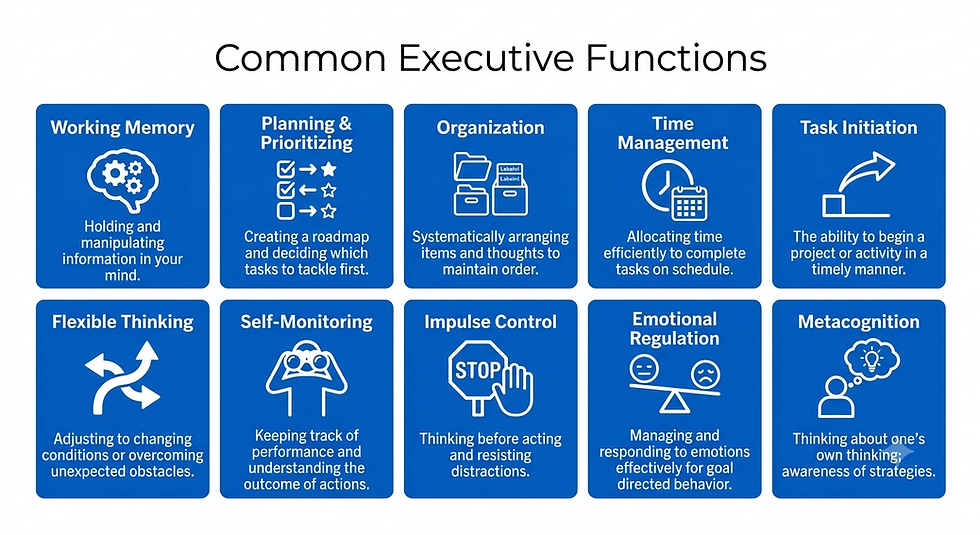
Laura explained why college applications are especially hard for students with task initiation and overwhelm. "Go work on your college applications" sounds like one task, but it's really dozens of tasks. Students have to plan, prioritize, start, manage time, and stay organized all at once, under real stress.
Key strategies to help students start and finish college applications
To help students initiate tasks without getting overwhelmed, focus on small, concrete routines:
Externalize the process. Keep every college, essay, recommendation, and deadline on one dashboard. Review it once a week, not daily.
Make the next step small. Swap "work on your essay" for a 15- to 30-minute task, like "draft the first five sentences."
Pick a Top 3. Begin each work session with just three priorities.
Set an application appointment. Schedule a consistent weekly work window, with phones away and a timer running.
Try body doubling. A parent can simply sit nearby and work on something else. The goal is presence, not supervision.
Use the five-minute start. When a student feels stuck, take finishing off the table: "Just open the document and work for five minutes."
Separate each of the writing steps. Brain dump, choose, outline, draft, then revise. As Laura put it, the goal isn't to make it great yet. It's to make it editable.
Work backward from deadlines. Set "do dates" for each milestone, and color-code tasks by urgency.
Many of these strategies can be applied to all types of assignments, not just college applications.
Keeping the peace at home
Parental anxiety often leads to repeated check-ins that feel like nagging to a stressed teenager.
Laura's advice for parents was to shift from reminding to coaching to preserve both progress and connection:
Instead of asking "Did you finish your essay?" try "What's your plan?" or "What's making it hard to start?"
Set up a "Parent Parking Lot." Write down questions as they come up during the week, and save them for one predictable weekly check-in.
Protect application-free time, and ask before helping: "Do you want support or space?"
Sometimes the most effective move is bringing in another trusted adult, such as a coach or counselor, so the parent doesn't have to be the accountability officer.
As Laura reminded families, “The application is temporary, but your relationship with your student is not.”
These were just a few highlights from the conversation. Special thanks to our guest experts, Adrienne Frumberg (Lighthouse Guidance) and Laura McMaster, Ph.D. (Frankenberger Associates), for sharing their strategies.
Looking for more expert-led sessions? You can explore upcoming topics on our Pathlitics Events Hub, or watch the complete replay of this webinar below.
Watch the full webinar recording
Enter your information below for instant access to the full video recording:


Comments