
What Is Executive Function Coaching? A Guide for Students

Updated: 3 days ago
You're Not Lazy or Broken What two coaches wish high school and college students knew about how their brains work.
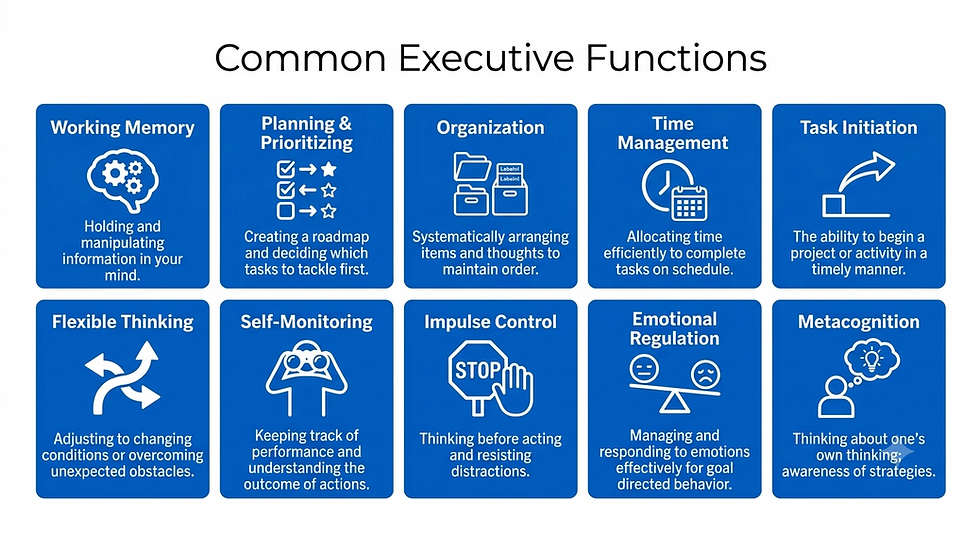
If you learn differently- ADHD, dyslexia, autism, anxiety, or some combination- you've probably been told a hundred times to use a planner, try harder, stay organized. What you haven't heard enough of: why those things are genuinely hard for you, and what it takes to build these skills.
We asked two executive function coaches, Cindy Palmer (Threshold Coaches) and Jasmine Badamo (Executive Function Magic), for the honest version. No sugarcoating, and no pretending a planner fixes everything.
It's Not Your Fault
Before jumping into tactics, both coaches name something most students carry but rarely talk about: shame.
Cindy: "Every neurodivergent human has lowercase-t trauma every day. You're in an environment not designed for your brain's optimal functioning, and you're making judgments about your own character based on peers."
Research suggests neurodivergent kids receive roughly three negative redirections or criticisms an hour in early school years, which adds up to an estimated 20,000 negative messages before middle school.[1]
Jasmine: "In conversations with families or teachers, I'll hear, 'We've suggested several resources, but nothing's really sticking.' It's common to find a student who feels a lot of shame around needing extra help because over the years that need has been linked to ugly judgments like ‘stupidity’ or ‘laziness.’ So shame is a real barrier to student buy-in. Once the shame is removed, access to resources could make a meaningful difference."
If any of that sounds familiar: you are not the problem. Your brain isn't broken- it just works differently, in a system that wasn't built for it.
What Executive Function Coaching Actually Is (and Isn't)
A lot of students come in expecting a hack- the one trick that finally makes everything click. That's not how this works.
Jasmine: "A lot of students, especially in high school, say, 'Tell me the magic hack that will solve all my focus issues.' I explain that while we can use different strategies to strengthen focus over time, focus might always take intentional effort. It gets easier, but you will likely always have to navigate around some level of executive dysfunction."
Think of coaching less like a prescription and more like the gym: your coach isn't fixing your executive functioning- they're helping you build it.
In a typical session, you might:
Figure out why you haven't started that paper yet (without getting lectured)
Practice writing an email to a professor you're scared to approach
Work through a panic spiral before figuring out three things to bring your nervous system down
Design a calendar that fits how your brain works- not your organized roommate's.
Cindy: "Instead of handing you a calendar system, it's a conversation around what kind of calendaring system will work for you, what hasn't worked and why, and what might work in the future. What did you forget last week? How can we remember things like that next week?"
Regulate First. Plan Second.
Here's something your planner can't do: if your nervous system is overwhelmed, no organizational tool is going to help.
Both coaches rely on a concept called the window of tolerance- the mental zone where your brain is calm enough to actually plan, problem-solve, and take action.
Above the window: you're anxious and spinning.
Below the window: you're burnt out, numb, or completely shut down.
In either state, the part of your brain that runs executive function goes offline.
Cindy: "Our first job with you is not to start that paper. It's for you and I to talk about your top three ways you can chill out when you're done with me. What will make you say, ‘Yes, I look forward to that moment’? Can you go do that before you enter into the four things you told me about?"
Getting regulated first isn't procrastination; it's a prerequisite. Learning where you are in that window, and having a real plan to get back to center, is one of the most practical things EF coaching builds.
Self-Advocacy Is the Skill That Changes Everything
In high school, a lot of advocacy happened on your behalf by parents and teachers. In college, that's your job. You'll register on your own for accommodations, notify your professors, and ask for help before things fall apart.
Jasmine: "I use coaching sessions as a space for students to practice self-advocacy in a low-stakes way. If meeting at a certain time of day doesn't work for you, or if something unexpected comes up, I want you to tell me and feel confident doing so."
Cindy shared a story about a 19-year-old who had never emailed a professor. He was scared- sure he'd be shamed. When she asked how he'd start the email, he said, ‘Well, I would tell him I forgot to turn it in.’ A gentle inquiry revealed: he hadn't forgotten. That moment, owning it, became the entry point for a real conversation about advocating for his needs with ADHD. He went on to seek out his professors proactively, treating them as resources instead of people to fear.
What EF Coaches Actually Spend Time On
Ask most parents what an executive function coach focuses on, and you'd probably guess planners and time management. Ask the coaches, and you get a different answer.
Cindy: "Emotional regulation. I wouldn't have said it two years ago. Now, absolutely."
Jasmine: "It's less common that a student doesn't have tools at their disposal. It's more often an issue of breaking down the mental barriers stopping them from exploring those tools."
You can have every accommodation, every app, every system- and still not use any of it if you don't believe things can get better. Building that belief is the real work.
What Success With EF Coaching Looks Like
Progress in EF coaching is rarely a straight line, and it’s almost never measured by GPA.
Jasmine: "A great sign of progress is when a task goes from being something we do together in session to something you can do independently between sessions."
Cindy: "We are helping students build systems, skills, and self-awareness so that their college journey becomes more their own... a big part of coaching is providing dignity amidst failure. Failure is not the enemy. It is often where we learn the most about what is and isn't working."
The goal isn't a 4.0. It's building enough self-awareness and confidence that when things get tough, you know how to handle it.
How to Find EF Support on Campus
Many colleges offer academic coaching, learning strategy sessions, and peer mentoring through their Academic Success Center, Disability/Accessibility Office, or Learning Resource Center. These services are often included in your tuition. As you research colleges, be sure to ask about these resources. And once you're on campus, make it a point to reach out early in the semester before stress builds up.
Key Takeaways
The shame you're carrying from school is real and isn't a character flaw. It's the predictable result of years spent in a system not built for your brain.
EF coaching isn't a hack or a system handed to you. It's skill-building- collaborative, reflective, and individualized.
Regulation comes first. An overwhelmed nervous system can't plan, so learning your own window of tolerance is foundational.
Self-advocacy is trainable and one of the most important skills you’ll learn. It starts in small moments and grows from there.
Success isn't linear and it's rarely measured in grades. It's measured in how much of this becomes yours to run.
Curious what executive function and disability support actually looks like at different colleges? Pathlitics has 600+ verified reviews from students who've been there- built specifically for students with learning differences and their families. Your family can get started with Pathlitics at pathlitics.com/parents
Cindy Palmer is the founder of Threshold Coaches, supporting neurodivergent students at universities across Washington State and online nationwide. Jasmine Badamo is the founder of Executive Function Magic, a private executive function coaching practice serving students from middle school through adulthood, based in New York's Hudson Valley.
References
Don't Let ADHD Crush Children's Self-Esteem, Michael S. Jellinek (2010) https://www.mdedge.com/psychiatry/article/23971/pediatrics/dont-let-adhd-crush-childrens-self-esteem
Comments