
Executive Function Coaching for College: A Parent's Q&A Guide

Updated: Sep 13
Experts share what you should know about coaching for students with ADHD, dyslexia, and autism, and how to determine if it is right for your student's college transition.
If you have ever watched your student fall apart trying to start an assignment (not because the work was too hard, but because something else seemed to block them), you were likely seeing an executive function challenge in action. College is the biggest executive function test a student will face. Without daily check-ins, parent reminders, or a strict high school routine, the loss of structure can quickly overwhelm capable freshmen with ADHD, dyslexia, or autism.
Executive Function (EF) coaching helps students build those crucial real-world skills (like time management, planning, and self-regulation) before that safety net disappears. If you are curious about what EF coaching actually looks like (or whether it is worth it), we asked two experienced coaches, Cindy Palmer (Threshold Coaches) and Jasmine Badamo (Executive Function Magic), to answer parents' and caretakers' most common questions.
Q: What even are executive functions?
Jasmine: "I start by introducing the basic concept of executive functions as higher order cognitive or thinking skills. I usually list out a few of the specific executive functions that most experts agree on like organization, time management, prioritization, mental flexibility, and emotional regulation. Oftentimes people don't realize that emotional regulation is also one of the higher order thinking skills."
Think of executive functions as your brain's control tower. They're the underlying skills that make it possible to set a goal and actually follow through on it- deciding what to do, when to do it, managing your emotions along the way, and adjusting your actions when things don't go as planned.
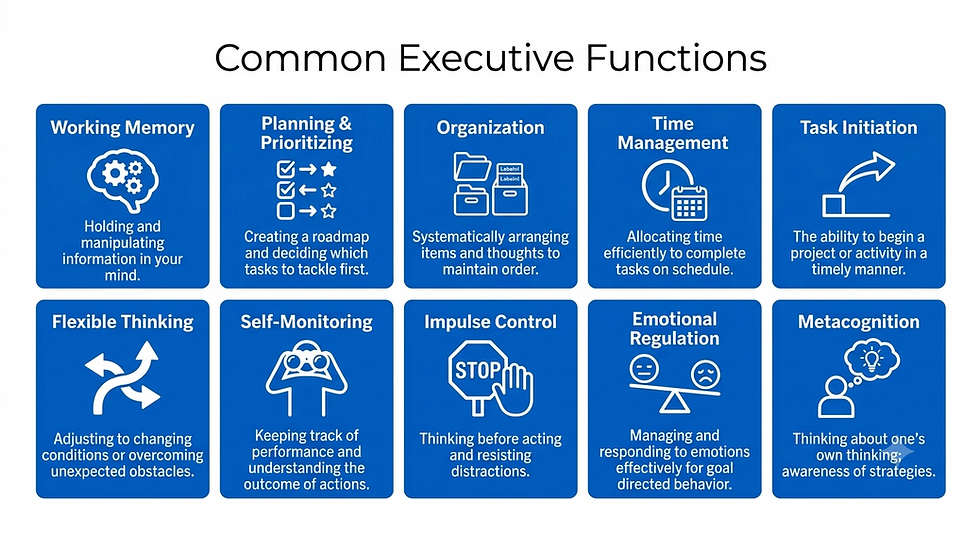
Cindy: "Some people list 15, some people list 20, some list 9. It's just different words around the same general concepts. What matters isn't the exact list. It's understanding that these skills underlie almost everything we expect a ‘successful student’ to do.”
Q: Why are some parents skeptical about executive function coaching and wonder if it’s necessary?
Cindy: "I do understand why parents have their doubts. There is an intangibility to executive functions, especially if you're a neurotypical parent thinking about executive function skills for your neurodivergent teen. There are some things that feel very natural to you that will be an absolute feat for your teen.
“This gap in lived experience is real. When you grew up with executive function skills that developed relatively smoothly, it can be hard to imagine why your student can't just "use a planner" or "start the essay." From the outside, it looks like a motivation problem. Or a discipline problem. Or even a character problem.”
Jasmine: "Traditionally, many of these skills have been viewed through a moralistic lens. For example, in order to be a ‘good’ student or person, you should be disciplined, have willpower, and not be ‘lazy.’ Now that there's more awareness of executive functions and what they are, it's easier for families and schools to understand that there are actual concrete skills underlying many, if not all, of the behaviors that we expect a ‘good’ student to have."
In other words: it's not a character flaw. It's a skill set that needs to be explicitly taught.
Q: I thought executive function challenges were just an ADHD thing. Is that right?
Not exactly. ADHD and executive function challenges overlap heavily, but they're not the same thing.
Cindy: "Can a student who does not have ADHD struggle with their executive functions? Yes, absolutely. You can be a neurotypical student in a new environment that's significantly more challenging, with less structure and more emotional stretching and really struggle there. Anyone who has additional cognitive load, which could come through stress or new environments, can be massively struggling with their executive function skills."
Jasmine: "I 100% agree with Cindy! In my work, I’ve found that there's executive dysfunction running throughout almost every form of neurodiversity, including if you want to consider certain mental health conditions a form of neurodivergence. In many ways, I find it difficult to separate executive functioning from neurodivergence."
So while ADHD is deeply connected to executive function challenges, students with dyslexia, autism, anxiety, depression, or who are simply navigating a major transition (like starting college) can all benefit from executive function coaching.
Q: What's the relationship between executive function and emotional regulation? I keep hearing this is connected.
This is one of the most important things parents need to understand and one of the most surprising.
Cindy: "If you're anxious or depressed, none of those executive function skills can happen effectively. Your prefrontal cortex, where all of these skills live, is literally biologically not able to do its thing. So getting emotional regulation under control first is really important, and that means coaching gets kind of interesting here."
She explains it this way: parents often come in saying, "I just want you to get my kid to use a planner." But a planner can't work if a student is already overwhelmed.
Cindy: "If they're anxious and depressed, they will not be inclined to open their planner and see where all their stuff is. The act of doing so requires them to muster the energy to overcome the depression, and if anxiety is involved, the planner is just a reminder that there is too much to do."
Jasmine built on this, describing the interconnected nature of executive dysfunction and emotional experience: "You can visualize it as a ripple effect: maybe you start with just executive dysfunction or academic struggles, but those struggles have a negative impact on your emotional state, how you experience the world, your self confidence, etc. All of that in turn reduces not only your ability to access your executive functioning skills, but also reduces your mental bandwidth for utilizing those skills. This then further exacerbates your inability to regulate yourself and your emotions. It's all interconnected."
The bottom line: emotional regulation isn't separate from executive functioning. For many students, it's the foundation everything else rests on.
Q: Is executive function coaching different from tutoring? Or therapy?
Yes, and the distinctions matter.
Tutoring is content-specific. A math tutor helps with math. An executive function coach uses content as a vehicle, but the real work is building the underlying skills.
Jasmine: "Tutoring is much more content bound. On the other hand, executive function coaching addresses foundational cognitive skills that are needed in almost every sphere of a person’s life. Because of that, I can use any content, from math homework to personal hygiene, and within that content find authentic ways to practice time management, prioritization, task initiation, self-regulation, etc."
Therapy goes deeper into emotional roots and healing. Executive function coaches, by contrast are more goal-directed and collaborative.
Jasmine: "The difference between me and a therapist is that my work is much more goal-driven. We look at a goal or stressor in your life, and then work together to make progress in that area. I'm trying to alleviate that stress in your life, or build up a skill that will help you alleviate that stress. Therapy, on the other hand, is much more exploratory."
She was also clear about the limits of executive function coaching: "I’m not a mental health professional, so I'm not qualified to help you really dig into emotional and psychological issues the way that a therapist can."
And both coaches agree on one thing enthusiastically:
Cindy: "I think the best executive function coaching comes in tandem with therapy!"
If your teen is working with both a therapist and an exective function coach, that's not redundant; that's the ideal setup.
Q: Does my teen need a formal diagnosis to benefit from executive function coaching?
No.
Jasmine: "Executive function coaching will help you bridge the gap between your current skill set and what is being demanded of you. So anytime there's going to be a big jump in that gap, that's where coaching can be really helpful."
A diagnosis can be useful in that it helps identify what specific challenges are at play. But any student who is struggling to manage the demands of their environment, especially during a transition like starting college, can benefit.
Q: What's the biggest myth parents believe about executive function coaching?
Cindy: "We have a lot of parents that come to us in the entering college phase that are like, 'I just want you to get my kid to use a planner. If they use a planner, then they will succeed in college.' Unfortunately, that is not true because there's so much underneath the planner that has to happen for them to even look at the planner."
Jasmine: "The biggest myth I come across is the laziness one. Many parents and caregivers perceive a teen’s inaction as laziness, saying 'I know they can do it because I've seen them do it before,' without fully appreciating just how much a person’s capacity can shift across time, subject, and context. What’s more, fluctuating capacity and difficulty with consistency are literal characteristics of ADHD and other disabilities that impact executive functioning."
EF coaching isn't a fix. It's a process of building skills, skills your student will carry into every area of their life.
Q: What does executive function coaching actually do for a student, in real terms?
Both coaches pointed to something bigger than grades or productivity metrics.
Jasmine: "The most exciting part for me about EF coaching is that I'm addressing the roots of a person’s struggle so that eventually, no matter what challenges or demands present themselves to this individual, they now have the foundation to decide what type of tool or strategy they want to use to address what's in front of them. In coaching, we’re building self awareness, confidence, and ultimately, independence."
Cindy: "I have seen students learn to advocate for themselves, and this is an immense hurdle for some. For instance, I had one student who had never approached a professor before. They were too ashamed, too convinced he'd be dismissed. After coaching, he not only sent the email; he started seeking professors out the moment he got confused. That is a huge success. They'll carry that experience and know that their efforts to advocate for themselves really matter. That is a life long lesson that will carry far into their future in all of their relationships."
Key Takeaways
Major transitions like starting college are exactly when executive function gaps become most visible, because the structure that used to compensate for them disappears.
Executive functions are foundational brain skills, not character traits and they can be explicitly taught and strengthened with practice.
Emotional regulation is the base of everything. If a student is overwhelmed, no organizational tool will help until that's addressed first.
Executive function challenges aren't only about ADHD. Any student with dyslexia, autism, or other learning differences, or one navigating high demands, low structure, or a major transition can benefit.
Executive function coaching is not tutoring and not therapy- but works best alongside both.
No formal diagnosis is required to benefit from executive function coaching.
The goal is independence, not reliance on the coach. A good executive function coach works to make themselves unnecessary, which matters most when a student is about to be on their own for the first time.
You can also send our What is Executive Function Coaching: A Guide for Students blog post to your student to read. Next in this series: Coming Soon! How to Find and Choose the Right Executive Function Coach for Your Student
Cindy Palmer is the founder of Threshold Coaches, supporting neurodivergent students at universities across Washington State and online nationwide. Jasmine Badamo is the founder of Executive Function Magic, a private EF coaching practice serving students from middle school through adulthood, based in New York's Hudson Valley.



Comments